The IPCC (Intergovernmental Panel on Climate Change) is holding elections from July 25 to 28 in Nairobi (Kenya). It will proceed to elect a new Bureau and the Bureau of the Task Force on National Greenhouse Gas Inventories (TFI).
The person who will chair the IPCC will be elected on July 26. Four people are running for the position. Climática has prepared a common questionnaire with 10 questions to know the proposals of the four candidates.
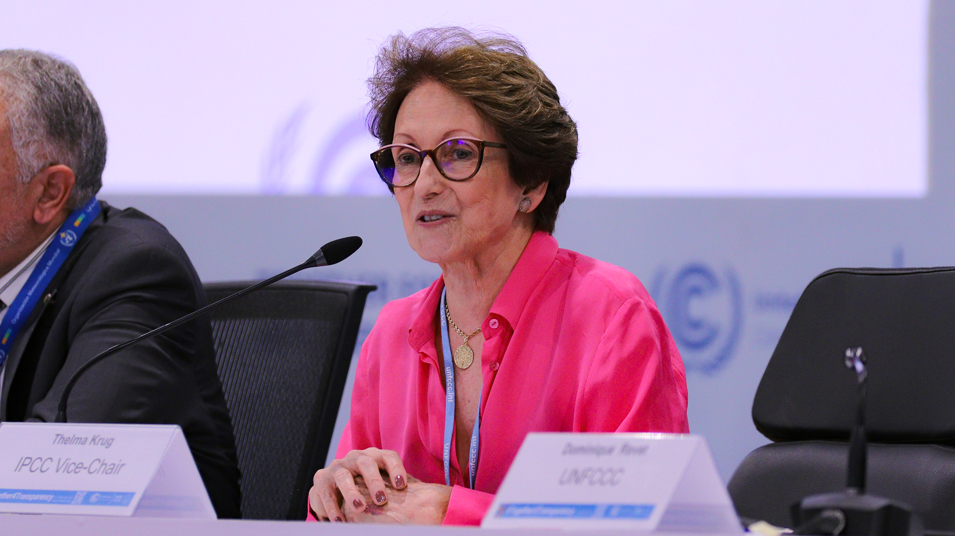
Researcher Thelma Krug, 72, was born in Sao Paulo, Brazil, where she still resides. Much of her professional life has been tied to the IPCC. Now, her future bifurcates in one of two directions: she will either become the first woman to lead the institution or, after two decades at the forefront, she will step aside and collaborate in positions with less responsibility, «as an editor, reviewer or similar».
For almost 40 years, Krug was the principal investigator for the National Institute for Space Research (INPE), an agency of the Brazilian government that is responsible, among other functions, for monitoring deforestation in the Amazon. In addition, she has held various positions within the executive branch. For 15 years she was the representative of her country in the negotiations during the Conference of the Parties (COP).
Krug, who holds a PhD in Spatial Statistics, has served as Vice Chair of the IPCC during the Sixth Assessment Cycle (2015-2023) and co-chair of the IPCC Working Group on National Greenhouse Gas Inventories from 2002 to 2015. Since 2020, she has been chair of the World Meteorological Organization’s Earth Observations Panel on Climate.
Throughout her career, Krug has received various awards from institutions and governments for her research, her outreach work and her negotiation skills. Climate change and forest protection are her preferred topics. With her knowledge, Krug hopes to lead the IPCC through a vital decade for climate action.
Why have you decided to run in these elections?
There were several factors that motivated me to accept the invitation of the Brazilian government to be nominated to run for Chair of the IPCC. Obviously, my contribution to the IPCC for the last 21 years, starting in 2002 as co-chair of the Task Force on National Greenhouse Gas Inventories, re-elected in 2019 for the same position, and being elected as Vice-Chair in 2015, is a clear indication of my commitment to the organization.
In my view, the position of Chair requires solid scientific background, professional recognition, good knowledge of the organization, good communication skills, leadership and determination. I am convinced that I have all the skills to successfully run for the IPCC Chair. Also, having a woman from a developing country with these qualifications to chair the IPCC, besides breaking the traditional male dominance experienced in the last 6 cycles (34 years), is a demonstration of equal opportunities regardless of the gender.
Why should you be the next person to lead the IPCC?
First, it is important to emphasize that all four candidates are qualified to be Chair of the IPCC. Obviously, if gender parity matters, then the male dominance of the IPCC chairmanship over the past 34 years should be considered, but not as a determining factor. The Chair of the IPCC represents the organization in many scientific forums. Hence, a solid scientific background would help the Chair disseminate scientific findings and explain the background information (climate modeling, scenarios) that is assessed by the authors. A long and logical trajectory within the organization, as well as experience in bridging science and policy, is also relevant. Science should be the pillar of an informed decision-making process, both domestically and internationally. I am sure that my scientific background, my experience as a UNFCCC negotiator for Brazil for over 10 years (my term ended in 2015 when I was elected Vice-Chair, to avoid any perception of conflict of interest) and my participation as policy developer and implementer at the Ministry of Science, Technology and Innovation, and at the Ministry of the Environment, count as important elements. But above all, I am known for my leadership skills – essential qualities for the Chair of an organization like the IPCC.
If elected the next IPCC chair, what actions would you like to implement?
Obviously, the IPCC Panel – made up of 195 member governments – is the main authority of the organization. Among other tasks, the Panel determines the work programme for a cycle, the scope and outline of the reports, issues related to principles and procedures of the IPCC and the structure and mandates of IPCC Working Groups and Task Forces. Consequently, any significant change is decided by the Panel, as necessary and by consensus. Obviously there is room for the Chair to take action. Should I be elected I will, together with the Bureau and Secretariat, work hard to have the Focal Points nominate qualified experts from their countries who, if selected, will enhance regional representation in the IPCC’s work. In addition, early on in the cycle and with the support of regional representatives in the Bureau, I will work to encourage academics and researchers to publish – and with this, to reduce the gaps in scientific literature that is assessed by authors from the Global North and Global South. Also, I will work hard to have as many member governments participate in the review of the report drafts, which is a unique opportunity to suggest literature (not necessarily in English, but with an English abstract) that to that point has not yet been assessed by the authors. This includes articles not published in high impact, peer reviewed, scientific journals, but that may contain relevant regional and local information to be included in the report. In addition, an important concern I have is ensuring that all authors have access to the published scientific literature, because much of this literature is only available if the interested author or the author’s institution pay for it. This results in inequitable participation by the authors. My idea, if elected, is to encourage, for instance, research foundations and international organizations to explore the possibility of covering the annual fees of relevant publications that could be made available as necessary.
What do you think the role of the IPCC should be in this and the following decades?
The role of the IPCC in the next cycle of 5 to 7 years will be to continue to provide governments with scientific information that they can use to develop climate policies and also as key input into international climate change negotiations, based on the assessment of scientific, technical and socio-economic information related to climate change.
The Working Group III report published last year had among its authors two employees of oil companies and a climate change denier. Do you think it is right that they are part of the IPCC reports? Don’t you think it could affect the Panel’s credibility?
No, I do not agree. The IPCC seeks to have a balanced assessment that includes the full range of scientific views, but protected from the influence of special interests. This is ensured by the methods IPCC applies in the author selection process, the many rounds of review of the reports by experts and governments and the Conflict of Interest policy that everyone that contributes to the IPCC has to follow.
One of the main criticisms of the IPCC is the lack of gender and country diversity among its authors. Do you share this view? What do you think needs to change for the Panel to improve in both areas?
The IPCC has procedures in place for the preparation of reports that include consideration of gender balance and geographical representation. Hence, an adequate representation of experts from countries from all regions should be reflected in the composition of the authors participating in a chapter. In addition to these procedures, and related to my response to the previous question, the selection of authors for a chapter “shall aim to reflect the range of scientific, technical and socio-economic views and expertise” as well as consider experts that have no previous experience in the IPCC. So, in terms of procedures, the relevant elements for a balanced and diverse composition of authors already exist. However, since the authors are selected from the lists of experts provided by governments and observer organizations, these lists might not include nominations that allow gender balance and/or diversity to be adequately reflected in each chapter. However, at every new cycle of the IPCC, the overall relative participation of female authors is increasing – 22% in the previous cycle and 33% in the sixth assessment cycle – and in many reports the participation of authors from developing countries is well balanced. In summary, procedures are already in place in the IPCC and there is no need for change, in my view. On the other hand, there is a need to have as many qualified expert nominations from each of the 195 member governments that are nominated, and in that respect I do see room for improvement. A more active engagement of the regional representatives in the Bureau (including the Chair) and the Secretariat with the Focal Points, if needed, might facilitate the regional diversity and representation that the IPCC strives for.
It is important to highlight that the IPCC has paid enhanced attention to gender during this sixth cycle, having created the Gender Action Team, co-chaired by vice-chair Ko Barret and myself, with the aim of developing a framework of goals and actions to improve gender balance and to address gender-related issues within the IPCC. More recently, a survey was carried out by a company commissioned by the IPCC to address issues related to equity, gender and inclusion. The survey engaged different types of participants in this cycle (authors, staff members of the Technical Support Units, the Secretariat) and its results will be instrumental in guiding actions by the Panel in the next cycle, if needed.
Another criticism that the IPCC often receives is that its reports use watered-down language in the Summaries for Policymakers (SPMs) because they result from negotiation with countries. Do you see this as an advantage or a disadvantage?
It is important to understand that the approval of an SPM results from an agreement among the 195 member governments on the policy-relevant scientific findings in the underlying report that are key inputs to inform both domestic climate-relevant policies as well as international negotiations. Achieving consensus, a collective position among diplomats from diverse political cultures on each finding in the SPM, without losing the scientific rigour of the assessment that led to that finding, is complex and challenging, especially given that the SPM should be short in length but still accommodate the interests and national agendas of all the member governments without compromising its own scientific assessment. In this respect, authors are invited to participate in the approval session of the SPM to guide the Panel. There is no statement in the SPM that does not result from the comprehensive assessment of the literature conducted by the authors. In summary, finding consensus that is agreed upon by all while maintaining the scientific integrity and rigour of the scientific assessment is difficult and obviously influences the language in the SOM messages. On the other hand, it still provides governments with an agreed understanding of the science of climate change, its observed impacts and projected risks, as well as mitigation opportunities.
The climate crisis and biodiversity loss are the two major environmental crises of our time and require joint action. A few years ago, the IPCC and IPBES published a joint report. Do you think that collaboration between the two should be further strengthened?
Obviously, the IPCC reports provide a clear relation between climate change and its impacts on biodiversity, based on the assessment of innumerous scientific publications around the world. And indeed, in 2020, a co-sponsored workshop was convened by IPCC and IPBES to identify the synergies and trade-offs between the protection of biodiversity and climate change response measures, such as mitigation and adaptation.
However, although both intergovernmental organizations have different objectives, they both aim at providing knowledge to inform policy decisions –IPCC on all aspects related to climate change, and IPBES on biodiversity loss and ecosystem services, and ways to strengthen cooperation with IPBES and other climate-related agencies might be one of the issues to be discussed by the Panel in the next cycle.
I would like to know your positions on certain technologies such as nuclear power, carbon capture and storage (CCS), carbon dioxide removal (CDR), renewable hydrogen and electric vehicles. Also, what are your views on meat, always a controversial topic?
Instead of giving my position with regard to these technologies, the science is clear regarding the stringent emissions reductions required to limit warming to the long-term temperature goals of the Paris Agreement. It is clear that all sectors, including energy, industry, transport, agriculture, forestry will have to undergo transitions to a low-carbon economy, which in most of the emissions pathways to limit warming to 2°C or 1.5°C, will require substantial energy system changes over the next 30 years. This includes reduced fossil fuel consumption, increased production from low- and zero-carbon energy sources, and increased use of electricity and alternative energy carriers which rely, with different shares across the pathways, on nuclear, biomass, non-biomass renewablesm, and fossil fuels in combination with Carbon Capture and Storage.
Carbon Dioxide Removal is also a key element in emissions scenarios that limit warming to 2°C or 1.5°C by 2100 and includes a portfolio with different methods, each one with distinct removal potential, technological maturity, adverse side effect, timescale of carbon storage, co-benefits, and governance requirements.
Regarding meat, it is also known that diets that are low in meat and dairy have a lower carbon footprint and hence, a shift to diets with moderate intake of animal-source foods can contribute to reducing GHG emissions.
Finally, do you consider yourself optimistic in the current context of climate and biodiversity crisis?
We know from the reports that we are not on track to limit warming to the long-term temperature goals of the Paris Agreement («Holding the increase in the global average temperature to well below 2°C above pre-industrial levels and pursuing efforts to limit the temperature increase to 1.5°C above pre-industrial levels, recognizing that this would significantly reduce the risks and impacts of climate change»). Despite the progress made since the previous cycle on the development of policies and laws addressing mitigation, there is a substantial implementation gap, but this does not mean that the course of action cannot be change, depending on political will, international cooperation, inclusive governance, among several other measures.
* Anna Oakes has assisted in translation.